Why (it is important) to recycle corrugated cardboard: the benefits
Staff Cart-One 21/01/2020 0
In Italy, there has been talk of separate collection for forty years, and among the materials with the most significant recycling percentages, we certainly find paper.
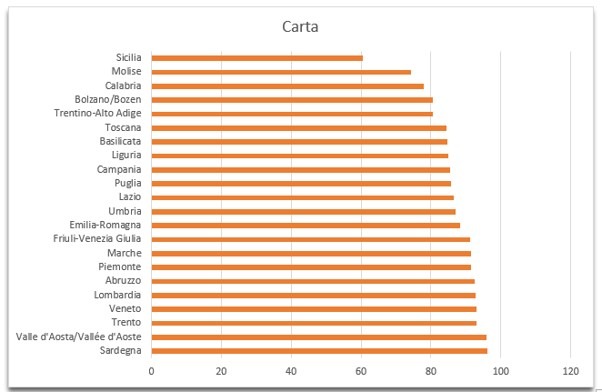
As we can see from Istat data referring to 2017 regarding the recovery of the urban fraction, each Italian region makes its own contribution in terms of paper and cardboard collection and recycling. There are some virtuous realities with recovery percentages approaching 100%, as in the case of Sardinia or the Valle D'Aosta.
If on one hand it is important for every citizen to do their part, it is also necessary that the companies that produce and use cardboard packaging are increasingly sensitive and attentive to the dynamics of recovery and recycling, which allow the placing on the market of products whose production cost, in terms of raw material, pollution, and energy used for their realization, is more sustainable.
Why is it important to recycle paper and corrugated cardboard? How is recycling done?
It is estimated that around 30% of the waste produced in Italy is made up of paper used for packaging, for a total of 11 million tons of paper and cardboard introduced into the commercial loop every year. This significant quantity represents a fundamental resource for the industrial branch that deals with the production of paper and cardboard for packaging, such as corrugated cardboard.
In fact, remember that paper, cardboard, and corrugated cardboard are 100% recyclable. Most of the paper and cardboard used for the production of packaging can be recovered and, through a process of requalification of the raw material, reused to create new paper and cardboard.
In detail, paper and cardboard for packaging are sent to recycling centers after collection and storage. At this point, a selection process isolates usable cellulose fiber from impurities. The paper and cardboard then undergo pressing, bale binding, and comminution.
A deinking process follows to eliminate any trace of ink. The cardboard is then reduced to pulp with the addition of hot water. The recycling process continues with a refinement phase that eliminates remaining impurities and slags to obtain a reusable cellulose paste.
However, this process cannot recover 100% of the raw material, so a percentage of virgin cellulose must be added to the cellulose pulp, which varies according to the type of paper/cardboard and its future use.
The paper is then wrapped in reels. The machine spreads, dehydrates, and presses the dough to obtain packaging and finished products.
What are the benefits of corrugated cardboard and paper recycling?
Recycling paper allows for energy savings of 65% during production. This also allows for an optimization of forest resources: in quantitative terms, 17 trees are saved for each ton of recycled paper produced.
The logistics and transport sector can obtain a significant economic advantage, as there is the possibility of compacting the cardboard and reselling it to recycled paper producers.
Furthermore, the cost of the recycled raw material is lower and the waste can be used as fuel, thus making production less polluting.
If it is true that paper and cardboard cannot be 100% recovered because the recycling process requires cellulose from new trees, we must note that these are responsibly managed forests. For each tree cut, three new ones are planted! The annual increase in forests in Europe is equivalent to 6,450 km², equal to the extension of 4,363 football fields per day (Source CEPI, FAO).
You may also like...
Andrea Pastore 17/06/2026
Innovation Academy 2022
seo 19/06/2026
What is meant by intelligent packaging?
seo 19/06/2026